Shop Titans: Crafting Tycoon
- 4.2
- Rating
- 5.00M
- Installs
- Free
- Price

 Analysis by App-foxy
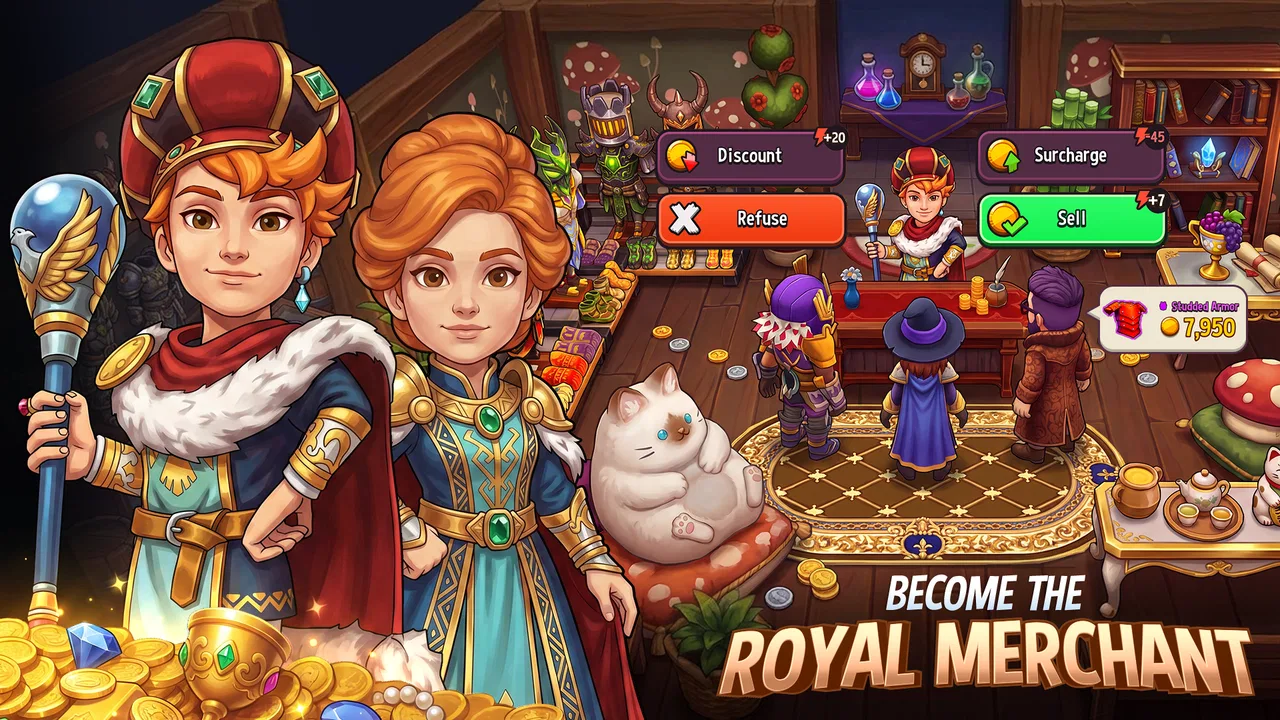
I went into Shop Titans: Crafting Tycoon expecting a light shop-management game and found something more involved: a business simulator built around crafting, selling, upgrading, and making a growing fantasy store feel busy. The basic idea is easy to understand, but the appeal comes from deciding what deserves my limited attention. I am not simply tapping through orders. I am choosing what to make, what to keep ready for customers, and when it is worth spending resources to improve the shop.
That makes it a good fit for players who enjoy steady progress rather than dramatic victories. It is free to play, belongs to the simulation category, and comes from Kabam Games, Inc. Its Teen content rating is worth keeping in mind, especially for families choosing games for younger players. The game has built a sizable audience, with over five million installs and an average rating of 4.2 from around 182 thousand ratings. Those figures do not replace personal experience, but they match my impression that this is a polished, established title rather than a short-lived experiment.
Why the first week feels so satisfying
The opening hours work because every action seems to feed another action. I craft an item, sell it, use the proceeds to improve the shop, and then gain access to a more interesting set of decisions. That loop gives the game a pleasant rhythm. Even when I only have a few minutes, there is usually something practical to do: start a crafting job, check customer needs, adjust my stock, or spend earned resources on progress.
You May Also Like

 AccuWeather: Weather Radar
AccuWeather Review: A Quick, Clear Forecast for Everyday Decisions
For everyday plans, the best forecast is the one you can understand quickly. AccuWeather makes rain timing, radar, and local conditions easy to act on, with a few trade-offs.

 Hill Climb Racing
Why Hill Climb Racing Still Turns Crashes Into One More Run
A tiny car, a bumpy hill and one more upgrade: Hill Climb Racing keeps resurfacing because its simple chaos makes every near-miss feel personal.

 AliExpress - Shopping App
AliExpress Makes Global Shopping Feel Personal, but Shoppers Bear the Risk
AliExpress turns a global marketplace into a pocket-sized discovery engine. Its reach is useful, its shopping loop compelling, and its trade-offs easy to miss.

 Lords Mobile: Kingdom Wars
Lords Mobile Is a Kingdom-Building Routine, Not a Quick Match
A case-by-case verdict on the building, battles, device demands, and social commitments that make Lords Mobile rewarding for some players and exhausting for others.

 PDF Scanner app - TapScanner
TapScanner Makes Paperwork Easier to Capture, Check, and Share
TapScanner makes scanning with a phone feel less like a rescue operation and more like a dependable step in getting work done. Its capture tools are useful, though not flawless.

 Block Blast!
 Shows How Much a Puzzle Game Can Leave Out
A quiet grid game shows why puzzle players increasingly value instant clarity, repeatable skill and low-pressure play—and where the genre still needs to catch up.
More From Our News Desk
View All News


The strongest early pleasure comes from seeing a small store become more capable. At first, I am thinking about individual items and immediate sales. Soon, I start thinking like a shopkeeper: which goods should be available regularly, which materials are worth holding, and whether a quick sale is better than saving something for a more useful purpose. That shift from clicking to planning is where the simulation starts to feel personal.
I also like that the fantasy setting gives the routine a little character. Crafting equipment for adventurers feels more inviting than managing an ordinary retail spreadsheet, even though the underlying decisions are still about supply, demand, timing, and investment. The presentation helps the early management tasks feel purposeful without requiring me to learn a complicated economic system before I can enjoy myself.
A realistic everyday scenario is easy to imagine. I might open the game while waiting for a train, queue up a few crafting tasks, sell finished goods, and leave with the shop in a better state than when I arrived. Later, I can return when I have more time and make larger decisions. This short-session flexibility is one of the main reasons I kept coming back during the first week.
The first important lesson: do not craft blindly
My biggest early mistake was treating every available crafting option as equally useful. It is tempting to produce whatever can be made immediately, but that can leave the shop with an awkward mix of goods and fewer resources for the items that matter more to my current direction. I got better results when I paused before starting a batch and asked what the shop actually needed next.
That small habit makes the game more strategic. I began grouping decisions into short plans instead of reacting to every button. For example, I might focus on preparing a useful selection of equipment, then use the resulting income for a shop improvement rather than scattering resources across unrelated projects. The game does not need to announce this as an advanced technique; it emerges naturally once the first excitement of unlocking things settles.
Another useful early habit is checking the whole production chain before spending. An item that looks attractive at the crafting stage may be less appealing if it consumes materials I need for several other jobs. Thinking one step ahead prevents the common feeling that progress has stalled for no obvious reason. I found that this was more important than trying to move as quickly as possible.
How it compares with simpler idle games
Compared with a straightforward idle game, this one asks more from me. I cannot rely entirely on passive progress and occasional collection. The shop works best when I make choices about inventory and production. That extra involvement is rewarding if I want a game that gives me something to consider, but it may feel like unnecessary work if I only want numbers to rise in the background.
It also differs from a traditional city builder. The focus is not on laying out a large settlement or watching a broad map develop. My attention stays close to the store, its goods, and the business decisions around them. Players who prefer a compact management loop may appreciate that focus. Players who want exploration, direct combat, or a constantly changing world should look elsewhere.
What keeps the game useful after the novelty fades
The real test for a management game is what happens after the first wave of upgrades. In my experience, the game remains interesting when I treat it as a routine rather than a single long session. The recurring value comes from having several kinds of progress available: improving the shop, refining production choices, and making better use of the resources that pass through the business.
That structure gives me reasons to return, but not every return is equally meaningful. Some sessions feel productive because I am working toward a clear improvement. Others are mostly maintenance. The difference depends on whether I have a small plan before opening the game. Without one, I can drift into collecting, crafting, and selling without feeling that I made a significant decision.
I found the game more satisfying when I set personal targets instead of chasing every possible upgrade at once. One session might be about stabilizing the supply of a particular kind of item. Another might focus on saving for a shop improvement. This approach reduces the sense of endless errands and gives ordinary actions a purpose. It also makes the game easier to fit around a real schedule.
The shop-management loop is especially suitable for players who enjoy gradual optimization. I can compare what I expected to earn with what actually happened, notice which choices created bottlenecks, and adjust the next cycle. That feedback is subtle, but it is what separates this from a purely decorative shop game. The store is not just something I watch grow; it is a system I learn to operate.
Where recurring value comes from
The most durable part of the experience is the relationship between preparation and payoff. Keeping useful materials available can make later sessions smoother, while poor preparation creates delays that I could have avoided. This encourages a light form of forecasting. I do not need a spreadsheet, but I do need to remember what I am trying to produce and why.
One practical workflow worked particularly well for me: before closing the game, I started the longest sensible crafting tasks, then returned later to process the finished goods and decide how to reinvest. That made short visits feel connected instead of random. It also prevented me from spending every session on tiny actions that produced little visible progress.
Another insight is that a full inventory is not automatically a healthy inventory. Holding too many materials or finished items can make the shop feel secure, but it can also tie up resources that would be more useful elsewhere. I learned to keep enough flexibility for the next decision rather than treating stockpiling as progress in itself. That trade-off is easy to miss during the exciting opening hours.
The game is also more enjoyable when I accept that not every opportunity needs to be taken. Trying to respond to every request or maximize every possible sale can turn the experience into pressure. I made better long-term progress by choosing a manageable direction and allowing some less attractive options to wait. That is a small but important lesson for anyone who tends to optimize everything.
How much attention does it demand?
It can work as a casual companion, but it is not completely hands-off. I would not recommend starting it if I wanted a game that could be ignored for long periods without consequences to my plans. The best results come from checking in often enough to keep production moving and to avoid wasting opportunities created by earlier decisions.
At the same time, I never felt that every session had to be long. A few focused minutes can be enough to queue work and make a useful sale. Longer sessions are better when I want to reorganize my approach or pursue a larger improvement. That range is valuable, although players who prefer one clearly defined session length may find the game’s rhythm slightly uneven.
The free entry point makes it easy to test that rhythm without committing money. In-app purchases range from $0.99 to $99.99 per item, so I would approach spending carefully. The important question is not whether an optional purchase looks convenient in isolation, but whether it changes the way I want to play. I preferred using the game’s normal planning loop before considering any paid shortcut.
Maintenance, friction, and the reasons fatigue can appear
The same systems that create depth can also create chores. When I am motivated, checking production and stock feels like running a small business. When I am tired, the same actions can feel like a list of errands. That is the central limitation of the game: its long-term appeal depends heavily on whether I enjoy repeated management rather than merely enjoying the idea of owning a fantasy shop.
Maintenance becomes more noticeable when progress requires several connected steps. A delay in one part of the process can affect the next sale, the next crafting decision, and the next upgrade. This is satisfying when I caused the problem and can solve it through better planning. It is less satisfying when I return mainly to discover that I have more routine tasks waiting.
I also noticed that the game can encourage a “just one more check” habit. There is often a reason to look again: a job may be finished, a customer may be waiting, or a resource may now be available. That can be convenient for short sessions, but it can also make the experience feel fragmented. I recommend setting a natural stopping point, such as completing one production cycle, instead of endlessly reopening the shop.
Who will probably enjoy it for months
I think it has lasting potential for players who like planning around constraints. If you enjoy deciding what to make, balancing immediate income against future progress, and gradually improving a system, the shop can remain engaging after the first week. The fantasy theme is a bonus, but the real attraction is the small-business puzzle underneath it.
It is also a good choice for people who like games that can be played in short bursts without abandoning longer-term goals. I could make progress during spare moments and still have meaningful decisions waiting for a longer session. That combination is more flexible than many management games that expect a large uninterrupted block of time.
I would be more cautious recommending it to someone who dislikes timers, repeated collection, or resource planning. Players seeking a story-led adventure may find the shop loop too repetitive. Likewise, anyone who wants direct control over a character and immediate action will probably enjoy a different type of simulation more. This is a game about operating a business, not about pretending the store is merely a gateway to another genre.
What can make long-term play feel tiring
The main source of fatigue is repetition without a fresh objective. If I open the game only to perform the same sequence every time, the satisfaction drops quickly. The solution is not always another upgrade; sometimes it is changing the way I approach production or giving myself a narrower goal. Still, the game could feel routine for players who need constant novelty to stay interested.
There is also a mental cost to managing resources while trying to maintain momentum. A decision that is efficient in the short term may not be best for the next stage of growth. That is good design for a simulation, but it means the game can punish careless play with slower progress. I appreciated the consequence, although I understand why some players may experience it as friction.
Paid options can add another layer of hesitation. Because individual purchases can reach a high amount, I would not make spending decisions while chasing a temporary feeling of impatience. The game is easier to enjoy when I treat purchases as optional conveniences rather than requirements for keeping up. If the possibility of spending distracts from the shop itself, the free experience may not feel comfortable enough.
My long-term verdict
After the novelty fades, Shop Titans: Crafting Tycoon earns its place through routine, not surprise. Its strongest quality is the way small choices connect: crafting affects stock, stock affects sales, sales affect upgrades, and upgrades reshape the next set of choices. That loop is more thoughtful than the simple premise suggests.
I would recommend it to a friend who enjoys calm but active management, especially someone who likes returning to a project and making it a little more efficient each time. I would suggest starting slowly, resisting the urge to craft everything immediately, and deciding what each session is meant to accomplish. Those habits make the game feel like a shop I am learning to run rather than a checklist I am trying to clear.
My reservations are equally clear. The maintenance can become repetitive, the production loop asks for regular attention, and players who dislike resource bottlenecks may lose patience. It is not the best alternative to an action game, a story-driven fantasy title, or a purely idle simulator. Its appeal depends on enjoying the middle ground: enough involvement to make planning matter, but enough flexibility to play in short visits.
For me, the lasting value comes from the quiet satisfaction of improving a process. I like noticing that a decision made several sessions earlier made today’s work easier. I like having a reason to save, prepare, and choose carefully. If that sounds appealing, this free simulation is worth trying. If the thought of maintaining a virtual shop already sounds like a chore, the first-week charm may not survive the month.
In the end, I see it as a game that rewards habits more than bursts of enthusiasm. Keep the goals manageable, watch where resources are going, and stop before routine turns into obligation. Used that way, it has enough depth to remain a regular companion rather than a title I install, exhaust, and forget.
FAQs for Shop Titans: Crafting Tycoon
01What is Shop Titans: Crafting Tycoon?
Shop Titans: Crafting Tycoon is a fantasy management and crafting game in which you run your own medieval shop. You create weapons, armor, tools, and other equipment, then sell them to adventurers preparing for dangerous quests. The game combines shop customization, resource management, crafting, character progression, and light role-playing elements, giving you several activities to manage rather than focusing only on combat.
02Is Shop Titans: Crafting Tycoon free to download and play?
Yes, Shop Titans: Crafting Tycoon can be downloaded and played for free on supported Android and iOS devices. However, it includes optional in-app purchases that can provide premium currency, bundles, convenience items, or cosmetic content. You can make progress without paying, but some upgrades and crafting processes may take time, so players should review the purchase settings and consider enabling parental controls if children use the device.
03Does Shop Titans require an internet connection?
Shop Titans is primarily an online game, so a stable internet connection is generally required to access the main features and keep your progress synchronized. Online access supports your shop, market activity, events, guild functions, and other connected systems. Because of this design, it may not be suitable for completely offline play during flights, commutes, or areas with unreliable mobile data or Wi-Fi.
04Can I play Shop Titans with other players?
Yes, multiplayer and social features are an important part of Shop Titans. You can join a guild, cooperate with other players, participate in shared activities, and benefit from teamwork while developing your shop and adventurer roster. The game is not a traditional real-time action multiplayer title, but guild interaction and cooperative progression add a social layer that can make long-term play more enjoyable.
05Is Shop Titans suitable for casual players and beginners?
Shop Titans is accessible to beginners because it introduces crafting, selling, upgrading, and adventurer management gradually. Casual players can log in to collect completed crafts, restock the shop, and send characters on expeditions without needing constant attention. Nevertheless, the game contains many systems, timers, resources, events, and upgrade choices, so players who enjoy steady progression and management will likely get more from it than those seeking quick, action-focused gameplay.
Pros
- Deep crafting system with many recipes and upgrade paths.
- Regular events add fresh goals and limited-time rewards.
- Trading with other players helps complete difficult orders.
- Runs smoothly on most modern Android and iOS devices.
- Town customization gives your shop a personal look.
Cons
- Progress can feel slow without spending premium currency.
- Energy and crafting timers may interrupt longer play sessions.
- Some valuable items depend heavily on random blueprints.
- The interface can feel crowded as your shop expands.
- Online features require a stable internet connection.

Shop Titans: Crafting Tycoon
Gallery